

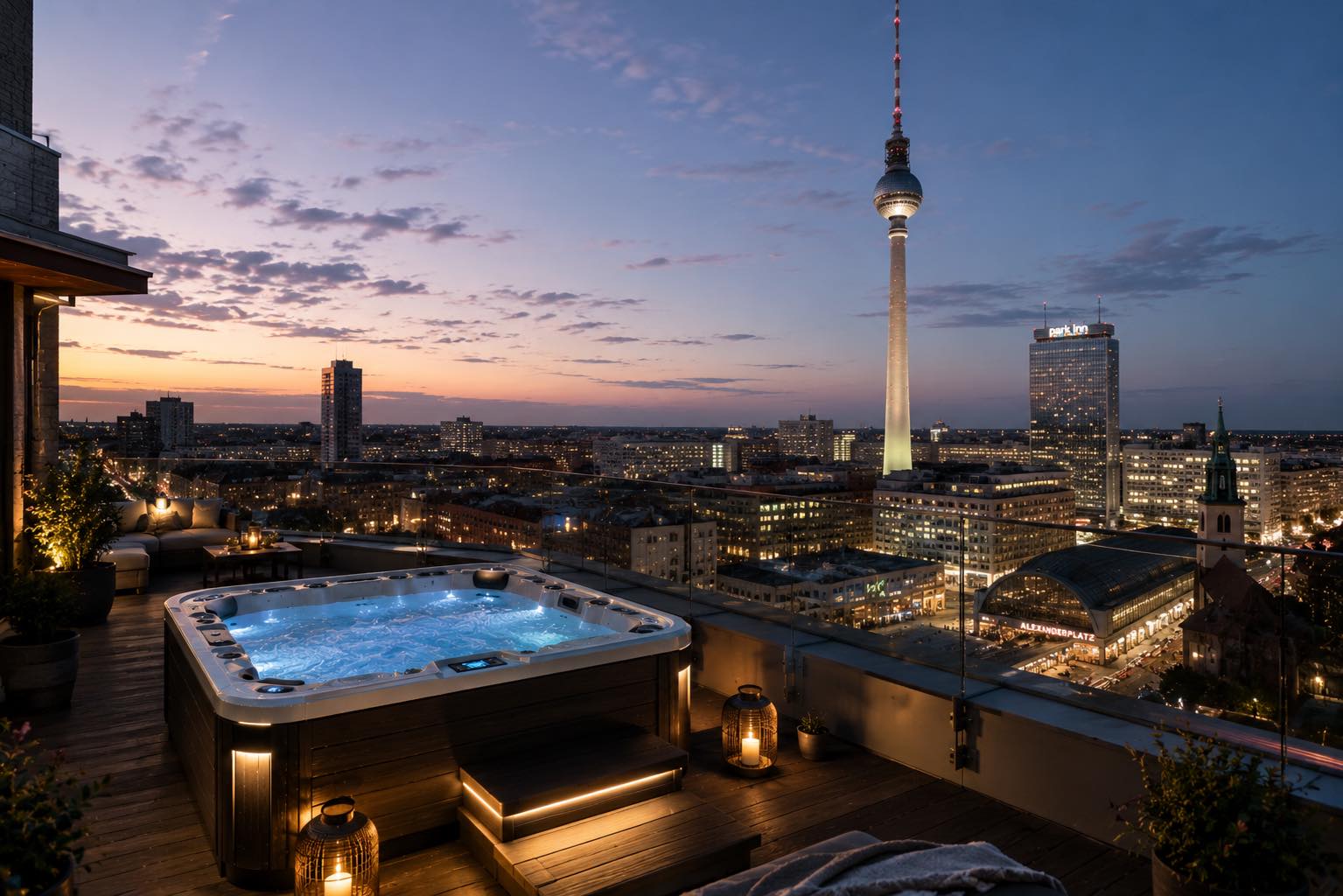
What do the maintenance costs of a jacuzzi depend on?
Purchasing a garden jacuzzi is just the beginning of your expenses. In practice, subsequent operating costs are the most significant—primarily electricity, water consumption, and maintenance chemicals. However, how much maintaining a jacuzzi will actually cost depends on several very specific factors. Some of them can increase monthly bills even several-fold.
Jacuzzi size
The larger the jacuzzi, the higher the energy and water consumption. A larger shell means more liters to heat and longer operating times for pumps and the filtration system.
Small 2–3 person models such as the Gamma 321A are usually cheaper to maintain than large family jacuzzis for 5–7 people. The difference is especially noticeable in winter, when the heating system must constantly maintain a high water temperature.
A larger spa also means:
- higher consumption of pool chemicals,
- a larger volume of water during changes,
- more powerful pumps and higher power draw.
Therefore, before purchasing, it is worth matching the size of the jacuzzi to the actual needs of the household members.

Number of users
Operating costs also rise with the number of people using the jacuzzi. More users means the water gets dirty faster, which leads to:
- more frequent filtration,
- higher consumption of chemical agents,
- the need for more frequent water changes.
Regular use by a large family or a group of friends can significantly increase the monthly maintenance costs of a garden spa.
Frequency of use
A spa tub with hydromassage used sporadically will generate lower costs than a model operating daily throughout the year.
The biggest impact here is from:
- pump operating time,
- frequency of water heating,
- filtration intensity.
In practice, people who use their jacuzzi every evening will consume significantly more energy than users who only turn on the spa on weekends.
It is worth remembering, however, that turning off the jacuzzi completely between baths is not always cost-effective. Reheating cold water often costs more than maintaining a constant temperature.
Water temperature
This is one of the most important factors affecting electricity bills. The higher the water temperature, the greater the energy consumption.
Users most often set:
- 36–37°C for daily relaxation,
- 38–40°C in winter or during intensive hydromassage.
Even a difference of 1–2°C can noticeably affect monthly operating costs. Especially in winter, the heating system then works much more intensely.
Season of the year
Jacuzzi maintenance costs change depending on the season. In summer, the device needs less energy to maintain temperature because the difference between the water and the environment is small.
In winter, the situation is completely different:
- the heater runs more often,
- heat escapes faster,
- insulation and a thermal cover are more important.
During severe frosts, power consumption can be several times higher than in the summer season.
Insulation quality
A well-insulated jacuzzi can significantly reduce operating costs. Modern premium models feature multi-layer shell and cabinet insulation, allowing them to retain water temperature for longer.
Poor insulation means:
- greater heat loss,
- more frequent heater operation,
- higher energy bills.
This is precisely why cheaper jacuzzis often turn out to be more expensive to operate than better-made premium class models.
Thermal cover
A thermal cover has a huge impact on maintaining water temperature. Most heat escapes through the surface of the jacuzzi, especially at night and in winter.
A good quality cover:
- limits energy losses,
- protects water from dirt,
- reduces evaporation,
- allows for reduced electricity consumption.
A worn-out or poorly fitted cover can cause very large heat losses, and thus significantly increase the monthly costs of using a jacuzzi.
How much electricity does a jacuzzi use?
Electricity consumption by a jacuzzi is one of the most frequently discussed topics before buying a garden spa. In practice, operating costs can vary greatly—everything depends on the size of the jacuzzi, how it is used, the water temperature, and weather conditions.
Modern models equipped with good insulation can be significantly more energy-efficient than older or cheaper designs.
Average energy consumption
An average garden jacuzzi consumes on average from about 150 to 400 kWh per month. In terms of electricity bills, this usually results in:
- about 150–300 PLN per month in summer,
- about 300–600 PLN in winter.
The smallest jacuzzi models for 2–3 people will draw less energy than large hydromassage tubs like the Alpha823A, which are equipped with more powerful pumps and a larger number of hydromassage jets.
Total power consumption is primarily affected by:
- jacuzzi capacity,
- frequency of use,
- set water temperature,
- thermal insulation quality.
Heater and pump operation
The most energy is consumed by the heater responsible for maintaining the water temperature. Its power is typically between 2 and 3 kW.
The heater turns on automatically when the water temperature drops below the set level. The colder it is outside, the more often it must operate.
The second important element is the pumps:
- hydromassage pumps,
- filtration pumps,
- aeration system.
During the bath itself, energy consumption temporarily increases because the pumps and heating system are running simultaneously. However, what matters most for monthly bills is maintaining a constant temperature around the clock.
Energy consumption in winter and summer
The differences between seasons can be very large. In summer, the jacuzzi needs significantly less energy to maintain water temperature because the environment is warm and energy losses are lower.
In winter, the situation is different:
- the heater runs much more often,
- the water releases heat faster,
- insulation and a thermal cover are more important.
At temperatures below zero, energy consumption can increase by even two or three times compared to the summer season.
Nevertheless, many modern jacuzzis are designed for year-round use, and appropriately insulated models can still be relatively economical.
Effect of ambient temperature
The greater the difference between the water temperature and the air temperature, the higher the energy consumption.
For example:
- maintaining 37°C in summer requires much less heater operation,
- in winter during freezing temperatures, the heating system operates practically constantly.
Costs are also affected by:
- strong wind,
- air humidity,
- exposure of the jacuzzi to an open space.
A jacuzzi placed under a shelter or protected from the wind usually consumes less electricity than a model standing in a completely open part of the garden.
How much electricity does a jacuzzi use?
Electricity consumption by a jacuzzi depends primarily on the size of the device, water capacity, quality of insulation, and frequency of use. Modern models equipped with good thermal insulation can be significantly more energy-efficient than older designs or cheaper models without full insulation.
Below is a detailed comparison of the ALPHA 823A, ALPHA 723, and GAMMA 321A models, along with indicative operating costs.

Comparison of technical parameters
| Model | ALPHA 823A | ALPHA 723 | GAMMA 321A |
|---|---|---|---|
| Number of people | 5 people: 3 seats + 2 loungers | 5 people: 2 loungers + 3 seats | 3 people: 2 loungers + 1 seat |
| Number of jets | 67 hydromassage + 10 air | 78 hydromassage + 10 air | 36 hydromassage |
| Hydromassage pumps | 3 × 2.2 kW | 3 × 2.2 kW | 1 × 2.2 kW |
| Circulation pump | 1 × 0.25 kW | 1 × 0.25 kW | 1 × 0.25 kW |
| Air blower | 1 × 0.7 kW | 1 × 0.7 kW | — |
Estimated energy consumption - summer
| Model | Average daily consumption | Average monthly consumption | Estimated monthly cost |
|---|---|---|---|
| ALPHA 823A | 5–7 kWh | 150–210 kWh | 195–275 PLN |
| ALPHA 723 | 6–8 kWh | 180–240 kWh | 235–315 PLN |
| GAMMA 321A | 3.5–5 kWh | 105–150 kWh | 135–195 PLN |
Estimated energy consumption - winter
| Model | Average daily consumption | Average monthly consumption | Estimated monthly cost |
|---|---|---|---|
| ALPHA 823A | 9–13 kWh | 270–390 kWh | 350–510 PLN |
| ALPHA 723 | 10–15 kWh | 300–450 kWh | 390–585 PLN |
| GAMMA 321A | 7–10 kWh | 210–300 kWh | 275–390 PLN |
Power consumption during jacuzzi operation
| System component | Power consumption |
|---|---|
| Balboa heater | 3 kW |
| One massage pump | 2.2 kW |
| Three massage pumps | 6.6 kW |
| Circulation pump | 0.25 kW |
| Air blower | 0.7 kW |
When all systems are fully operational, ALPHA models may momentarily draw over 10 kW of power. In practice, however:
- pumps operate periodically,
- hydromassage does not work continuously,
- the biggest impact on bills is maintaining water temperature.
Cost of the first jacuzzi water fill
The first fill of a jacuzzi is a one-time cost depending mainly on:
- model capacity,
- cost of water and sewage in a given region,
- filling method.
With average water and sewage prices in Poland, the total cost for 1000 liters (1 m³) is usually around 15–25 PLN.
Estimated cost of the first fill
| Model | Capacity | Approximate fill cost |
|---|---|---|
| ALPHA 823A | 1160 l | approx. 20–35 PLN |
| ALPHA 723 | 1250 l | approx. 20–40 PLN |
| GAMMA 321A | 850 l | approx. 15–25 PLN |
Total cost of the first jacuzzi startup
The biggest expense at the first startup is not the water itself, but heating it to a temperature of about 37°C.
| Model | Water fill cost | First heating cost | Total first startup cost |
|---|---|---|---|
| ALPHA 823A | approx. 20–35 PLN | approx. 35–50 PLN | approx. 55–85 PLN |
| ALPHA 723 | approx. 20–40 PLN | approx. 40–60 PLN | approx. 60–100 PLN |
| GAMMA 321A | approx. 15–25 PLN | approx. 25–40 PLN | approx. 40–65 PLN |
*At an electricity price of approximately 1.0–1.3 PLN/kWh, the cost of using a jacuzzi may vary depending on the energy tariff and the region of Poland.
The influence of insulation on energy consumption
ALPHA models are equipped with:
- 3 cm ThermaCoat Premium foam,
- insulated base,
- thermal cover that reduces heat loss.
Thanks to this:
- the heater turns on less frequently,
- the jacuzzi maintains temperature longer,
- operating costs in winter are significantly lower than in models without full insulation.

Summary
ALPHA 723 is a model with very high hydromassage performance and a large capacity, which is why its energy consumption is slightly higher than in the case of ALPHA 823A. At the same time, the use of 3 cm ThermaCoat Premium insulation and a thermal cover allows for significantly reducing heat loss and maintaining reasonable operating costs throughout the year.
GAMMA 321A remains the most cost-effective model to operate thanks to its smaller capacity and single hydromassage pump.
Power consumption by a jacuzzi depends mainly on water temperature, weather conditions, and the quality of the device's construction. The highest costs are generated by maintaining a constant temperature, especially in winter.
A well-insulated jacuzzi with a solid thermal cover, however, can significantly limit energy bills and make year-round spa use much more cost-effective.
Share:
Which sauna should you choose for your home? A complete guide for 2026
How to buy a hot tub or sauna in installments? A practical financing guide