

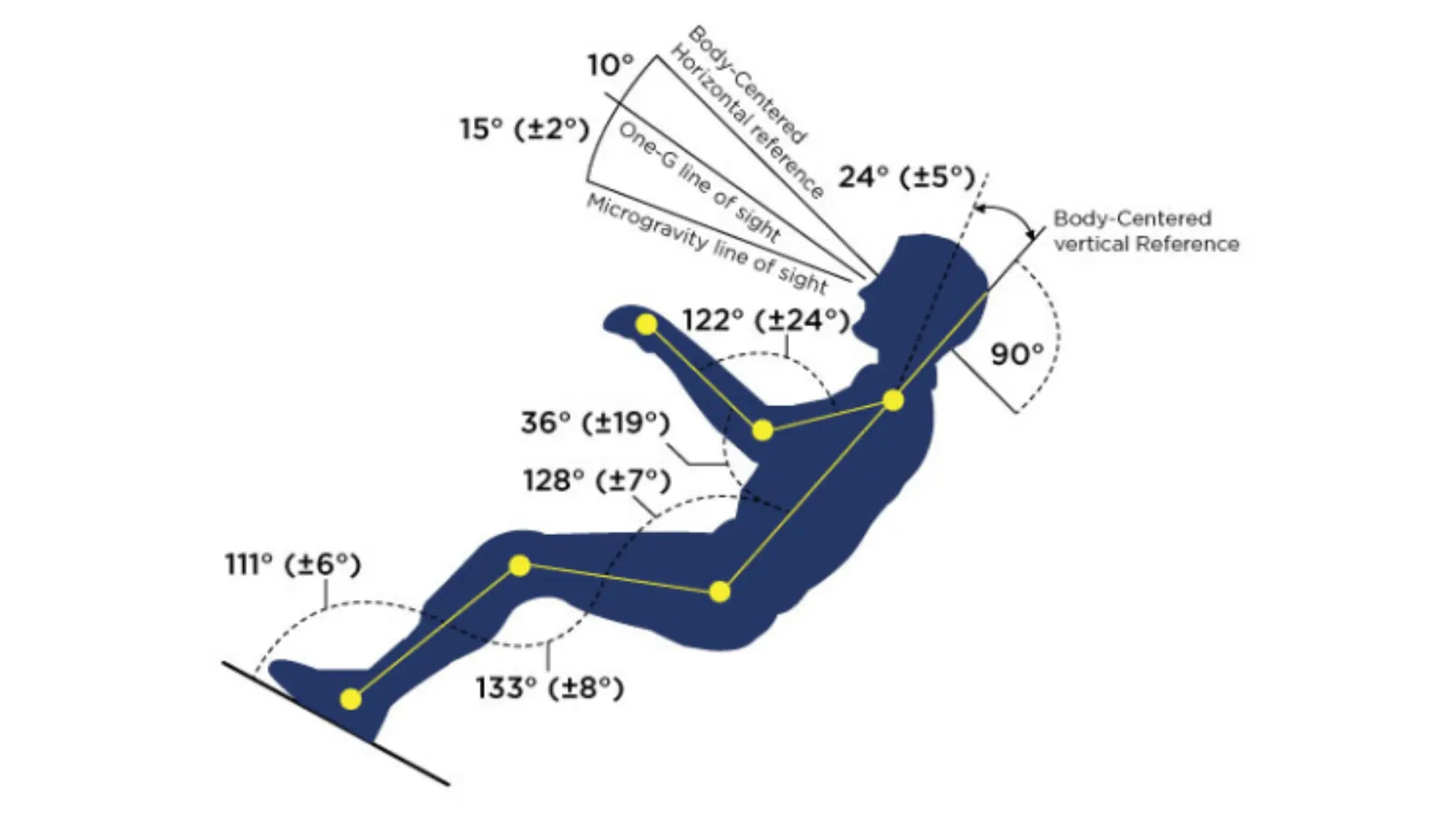
It can be two-stage or three-stage. The astronaut position, as it is called, is an incredibly interesting feature of our massage chairs. Today, we want to tell you more about it: where it came from, what characterizes it, and how it affects our body.
However, before we move on to space technologies, we must tell you about down-to-earth matters – such as the strain we put on our spine every day...
A review of spinal structure
We sit down, stand up, walk, bend over, and lift things – we perform all these activities naturally, without thinking; they are an inseparable part of our everyday lives. We therefore assume that our spine is prepared for them by nature.
And yet... not entirely.
Recall the structure of the spine. It is made up of vertebrae connected by intervertebral joints, called discs. A disc connects two adjacent vertebrae, creating a motion segment. Intervertebral discs also absorb the loads that the spine is exposed to. The nucleus pulposus deforms during the movement of the vertebral bodies: the annulus fibrosus bulges in the opposite direction to the movement being performed. Thus, bending the spine causes tension in the posterior structures of the annulus fibrosus, while extension causes tension in the anterior structures.
As a result of movement and while maintaining a position, compressive forces are created, which exert pressure on the intervertebral disc. This causes an increase in pressure in the nucleus pulposus of the disc, which in turn leads to stretching of the annulus fibrosus surrounding the nucleus.
Excessive compressive forces can lead to damage to the annulus fibrosus and destruction of the entire intervertebral disc. The greatest impact on the load on the intervertebral disc is caused by body position and additional loads.

What effect do standing, sitting, and lying down have on the spine?
All these positions are natural for us: we stand in line every day, sit while working, or lie down when we sleep. But do you know which of these positions puts the most strain on our spine?
Studies from 1964 showed that in a standing position, we put 100% load on the disc located between the third and fourth lumbar vertebrae. However, the sitting position puts 30% - 40% more load on this disc than standing.
Bending the spine forward increases the load on the disc. A sitting position with a forward lean causes an 85% increase in pressure in the nucleus pulposus compared to the pressure in a standing position, while leaning forward while standing increases pressure by 50% compared to a straight standing position.
A sitting position with the backrest tilted backward reduces the pressure inside the nucleus. Sitting on a classic chair with a 90-degree backrest significantly increases pressure, while it can be lowered more than fourfold with a 120-degree backrest. Publications from subsequent years have shown that the greatest load occurs during forward bending of the spine combined with rotation – that is, when we bend and twist at the same time.

Space technologies, or Zero Gravity – the astronaut position
Our spine doesn't have an easy life on Earth, but it didn't have it easy in space either. The American agency NASA spent a long time looking for a way to reduce the G-forces that astronauts were subjected to during launch. And since American scientists can always be counted on, they managed to solve the problem ;)
"Astronaut position" is a neutral body position that reduces the pressure the body exerts on itself under the influence of gravity. It is also sometimes called the weightlessness position. All body systems are relieved: joints and muscles relax, the circulatory system works more efficiently, and the body regenerates faster.
The astronaut position in massage chairs
It is no longer a mystery why every Casada massage chair is equipped with a weightlessness position.
Thanks to the astronaut position, the body, freed from all loads, relaxes and regenerates more efficiently. This is why this position is so comfortable, and why we like to doze off in it.
In our massage chairs, you can adjust the body recline – most chairs have a 2-stage adjustment, some have a 3-stage Zero Gravity position. The angles at which your body is set remain constant, but you can adopt a more upright or reclining position, depending on your preferences.
Share:
PowerVib - 21st century vibration dumbbells
Braintronics - for a better sleep