

Our daily grind
There is a proverb that says "no pain, no gain," and we Poles take this very much to heart.
We spend an average of 8 hours a day at work - that's a full 1/3 of the day, five days a week. According to the "Working time in 2019–2020" report prepared by Eurofound in 2020, Polish employees worked 1,848 hours per year. In the same period, Danes spent 200 hours less at work.
Work occupies a large part of our lives and is intertwined with it - as it turns out, separating life from work is easy only in theory. In practice, we bring our personal stresses to work and take our professional ones home with us. This is why, after a morning argument with our son, we cannot focus on a business meeting, and after a hard day at work, we snap at our partner.
The HRK Group published a "Stress at Work 2021" report, which shows that employees of large corporations are the most stressed. Among them, women feel stress even several times a week (38%), and men several times a month (30%). Significantly, the level of stress at work for 71% of respondents increased year-on-year from the fourth (14%) to the fifth degree (29%) on a five-point scale. As many as 19% of respondents declare that they constantly feel stress at work. This number has increased by as much as 15% compared to the previous year.

Stressed employee = disadvantaged employer
Small doses of stress are necessary for us. This is a primal mechanism that triggers the "fight or flight" response, which helped prehistoric people survive in the bush, and today, for instance, gives modern humans the strength to escape or defend themselves against an attacker in dangerous situations.
Chronic stress is very bad for our health. It causes, among other things, lowered immunity, headaches, chronic fatigue, heart disease, obesity, depression, and insomnia.
Let's not kid ourselves. A stressed employee is not bursting with energy for work or creative ideas. They perform their job, they probably try, but their body and psyche show a yellow card.
Sometimes they show a red one...
In 2020, people insured by ZUS (Social Insurance Institution) spent a total of more than 17.6 million days on sick leave due to reactions to severe stress and adjustment disorders, depressive episodes, and recurrent depressive disorders, which was more than twice as much as in 2012 (8.2 million days).
If we wanted to "justify" these figures with the pandemic, we cannot do so completely. Already studies from 2016 showed that in Europe, stress ranks second, after musculoskeletal disorders, among the most frequently reported health problems related to professional work. Estimates from that time suggested that as much as approx. 45% of employee absences could be caused by work-related stress (according to the British government organization Health and Safety Executive). Other experts, including those from the HR consulting firm PEOPLE, believed that it was responsible for as much as approx. 60% of absences.
Every coin has two sides. Facing the stressed employee is the employer who bears the costs of stress. What costs? Even just the easiest to calculate costs of an employee's salary while on sick leave, or costs related to hiring a new employee (recruitment, medical examinations). We must also include the consequences of lower work quality, delays, and an increased risk of an accident at work.
If an employee is stressed, both sides lose.
Chillroom - reduce stress at work!
According to health and safety regulations, every office must be equipped with a so-called break room. In the past, this was usually a "closet" equipped with mismatched chairs and a couch, a kettle, and a cabinet with dishes. Fortunately, this is already a memory of a bygone era.
Modern employers are aware of how important employee well-being is: their mental comfort and good health, which is why they are increasingly investing in so-called chillrooms, i.e., relaxation rooms.
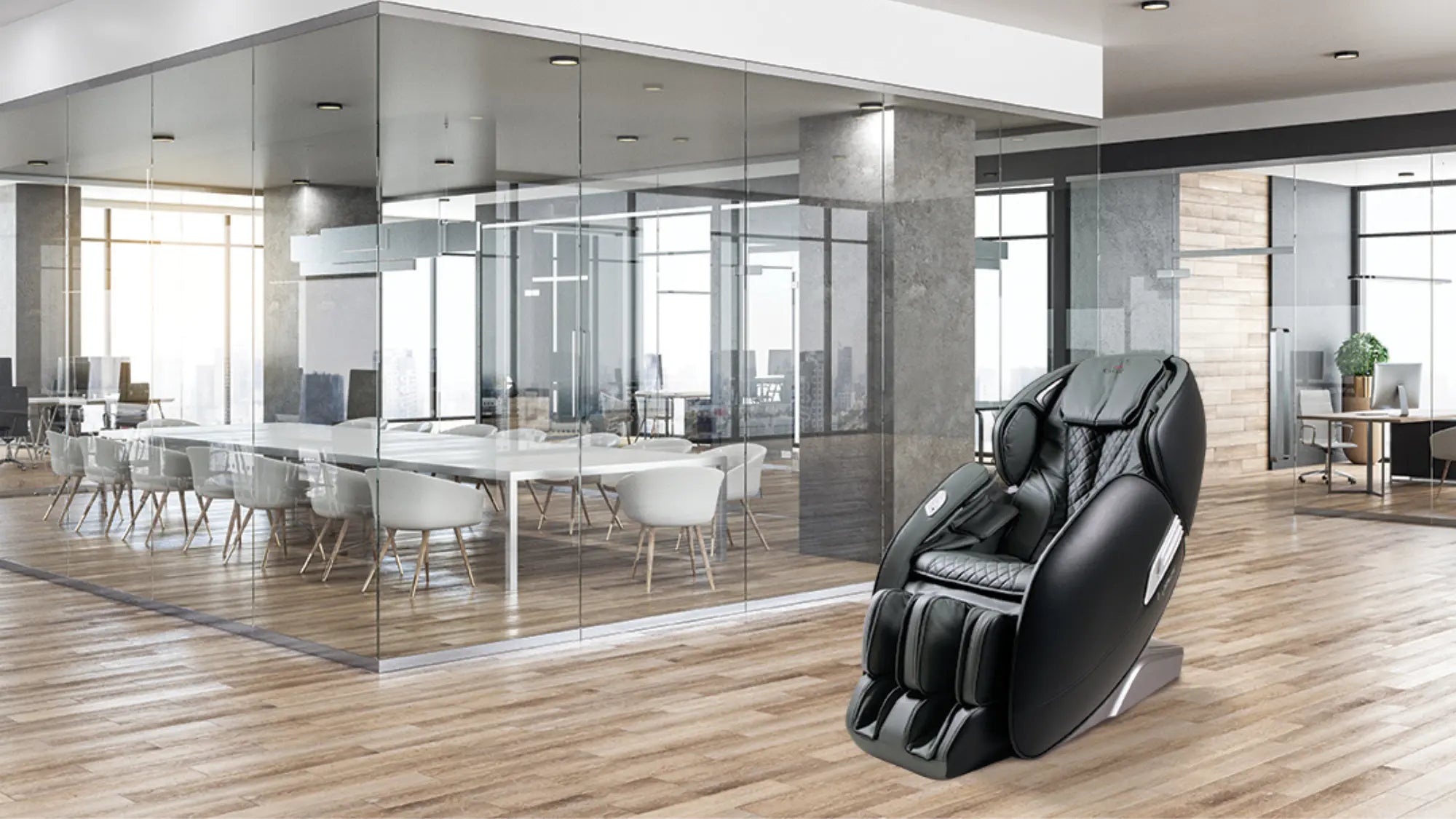
How to properly equip a chillroom? It might seem that there is no single answer to this question, because everything depends on the staff: their age, industry, interests, and work system. And yet there is a universal item that will work in absolutely every relaxation room: a massage chair.

A chair that massages the body and relaxes the mind
Regardless of whether we are 25 or 45 - our bodies suffer the painful consequences of office work. Man was not created by Nature to sit. Nor was he programmed for constant struggle with stress. That is why a massage chair is an absolute must-have in every office.
The chair's operation is multidimensional. In the physical dimension, it will take care of the body. It will massage tense neck muscles, loosen the lower back, and take care of tired legs, feet, and even arms and hands. It will therefore remove the physical effects of a sedentary lifestyle and hours of staring at a computer or phone screen.
The chair will also enable deep mental relaxation. During the massage, we unwind and relax. But that's not all - Casada healthcare massage chairs work with the Braintronics app, which helps to "relax" brain waves. Such anti-stress therapy is combined with a gentle full-body massage and, when used regularly, helps to cope with the effects of stress: it facilitates falling asleep and improves sleep quality, restores inner peace, increases creativity, and adds energy.
Time for relaxation
A big advantage of the massage chair is the adjustment of the duration of the massage. Relaxation time can therefore be adapted to your schedule.
Another advantage is the diverse automatic massage programs. Massage chairs have anywhere from a few to several dozen full-body massage programs. These include relaxing, stretching, analgesic massages, or those focused on releasing tension in specific parts of the body. Everyone will therefore find the right massage for themselves for a given day.
In the case of equipment shared by all employees, hygiene plays a significant role. Massage chairs are covered in eco-leather - they are easy to keep clean or disinfect after each use.
Adapted to any space
A chillroom in an office or a chillroom in a corporation - a massage chair will fit into any of them. We can put it in a small room that will be intended only for relaxation, or in a large break room, where it will complement the range of attractions.

It is worth emphasizing that in modern times, when employers are trying to return employees to work in the office from home office mode, a massage chair is an extremely effective argument.
Employees are more willing to return to offices equipped with a relaxation zone.
How to choose a massage chair for a chillroom?
Choosing a massage chair suitable for all employees is a huge challenge. It is definitely worth betting on versatile models: ones that will adapt to users of different heights and provide a large selection of diverse massage programs, such as, for example, Aura or Alphasonic III models.
The safest thing is to invite our mobile massage chair showroom to the office - then the Management and employees have the opportunity to test 3 different models.
Our consultants are happy to help you choose the best model for your chillroom, and if you are interested in leasing - they will prepare the most favorable offers for you from leasing companies with which we have been cooperating for many years.
In modern times, a chillroom is not a whim, but a necessity. Thanks to a moment of relaxation, the well-being of the staff and the atmosphere at work improve, and this leads to increased efficiency and creativity of employees.
Besides, it is worth taking a break from work, stress, and problems for a few minutes. To reset and recharge your batteries. Quite simply, in a human way.
Share:
Two in one: a TV armchair with a massage function
Are massage chairs healthy?