

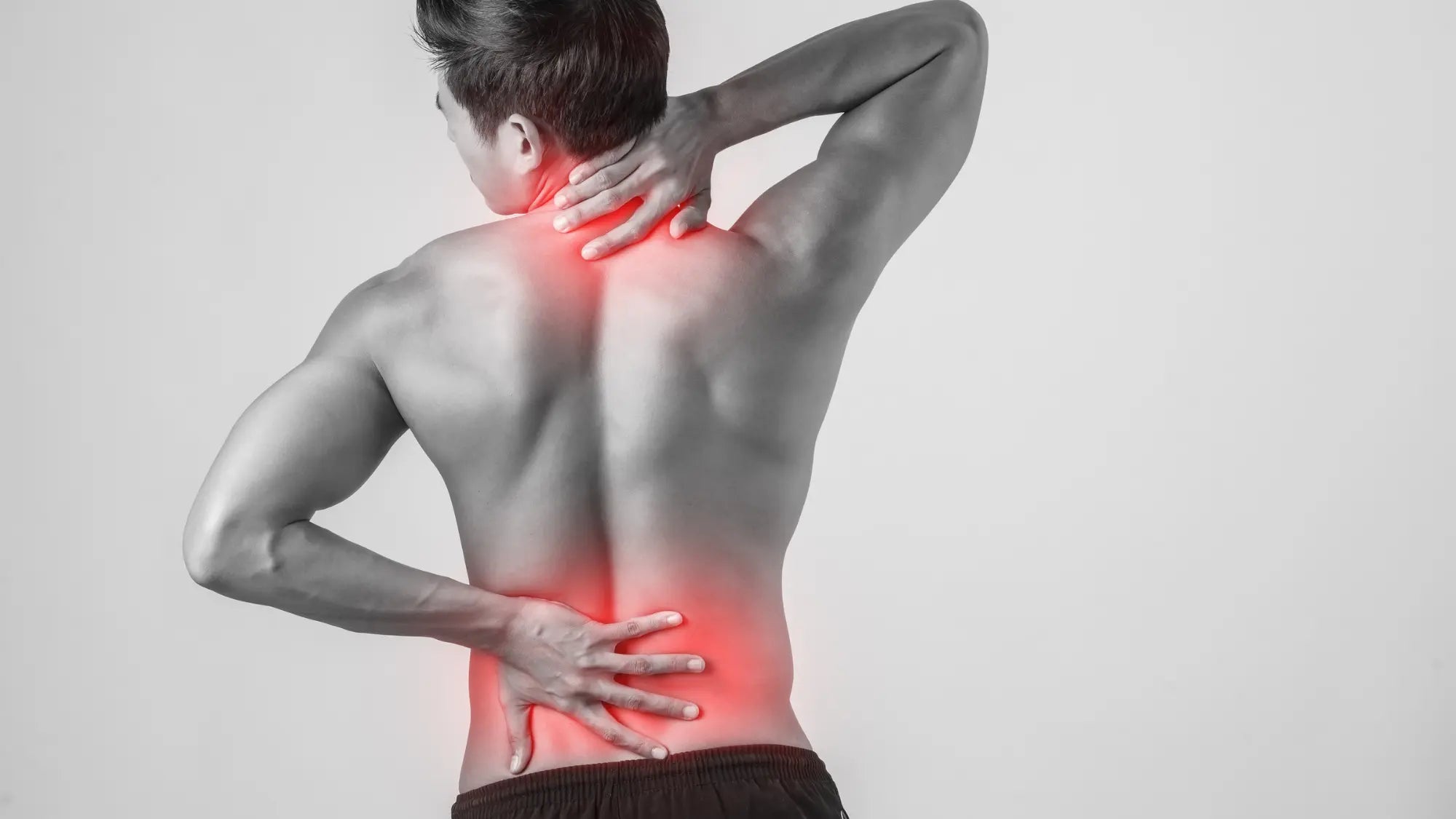
Nature was apparently unable to predict what man would do with his body. We have inherited from our ancestors a structure that enables us to withstand various stresses, but not those caused by a dozen or so kilograms of excess weight, carrying heavy bags, or sitting for hours at a computer or behind the wheel of a car. Unfortunately, both excessive effort and lack of movement are harmful to the spine. So, let’s find a golden mean.
The spine - a flexible scaffold
First and foremost, the spine allows us to stand upright. But not only that. It supports the head, stiffens the skeleton, and protects the spinal cord from injury. The vertebrae, stacked one on top of the other, form joints that allow us to easily assume various positions. Between the vertebrae are flat, flexible cushions (professionally called intervertebral discs or discs, and popularly known as discs), which prevent the individual vertebrae from colliding with each other even under very heavy loads or sudden movements.
The spine also owes its flexibility to its natural curves. Properly positioned, it is shaped like two “S” letters standing on top of each other: the thoracic and sacral segments curve backward, while the cervical and lumbar segments curve forward.
The mobility of the lower back, necessary for daily life, is provided by the ligaments fused with it, as well as the back and abdominal muscles. The back muscles, arranged symmetrically on both sides of the spine, usually work in pairs – when one contracts, the other stretches. The contracting muscle pulls on the bone to which it is attached, and we can perform a movement, such as a side bend. Conversely, the contraction and stretching of the abdominal muscles allow us to bend forward and straighten up.
For the back and abdominal muscles to fulfill their tasks, they must be strong and fit. Flaccid, hardened, or constantly cramped muscles can cause severe pain when performing any movement. Sometimes, they even make moving impossible. Furthermore, when muscles and ligaments are overly stretched or tense, the bones and joints of the spine deteriorate more quickly.
Important! We asked internet users: how do you lift weights? Here are the results:
- I always remember to do it from a slight squat – 40 percent.
- I never think about it – 38 percent.
- with straight legs, although I know it's incorrect – 22 percent.
The spine is a load-bearing pillar
It consists of 33 or 34 vertebrae:
- At the very top are 7 cervical vertebrae. They are the smallest and most mobile in the entire spine. Thanks to them, you can move your head side to side, up and down, and even make circles.
- Below are the thoracic vertebrae. There are 12 of them. 12 pairs of ribs emerge from them. 10 pairs connect at the front to the sternum and form the rib cage. It protects the most important organs and ensures the lungs can breathe freely.
- The next 5 vertebrae are called the lumbar vertebrae. They are the most loaded when we walk, lift weights, or sit. For this reason, we most often feel pain in the lumbar region of the spine. At the level of the buttocks, the lumbar vertebrae connect to the sacrum.
- 5 fused vertebrae form the sacrum. This bone, along with the pelvis, protects the bladder and reproductive organs.
- At the very bottom, we have the coccyx. This is 4 or 5 fused vertebrae. It serves no function and is an atavistic remnant from our ancestors.
To keep the spine flexible and prevent the vertebrae from colliding and crushing each other, they are separated by intervertebral discs. They lie between the vertebrae on a thin layer of cartilage. In the center of each is the so-called nucleus pulposus. Because it is filled with a gelatinous substance, the discs are resilient and can act as shock absorbers when we walk, jump, or run.
The vertebrae stacked one on top of the other form a protective tunnel for the spinal cord. This is the most important "info-highway" in our body, through which impulses travel to the brain. Spinal nerves branch off from it through intervertebral foramina. As they branch out further, they form a communication network between the brain and the rest of our body.
Do this necessarily
- When your neck hurts. Soak a small towel in well-warmed water and wring it out. Place it on the back of your neck. Hold the ends with your hands and pull the towel once to the right and then to the left. Do this for at least 5 minutes. The heat and neck massage will do the trick.
- When your nape hurts. Warm the painful neck and nape with a hair dryer, then ask someone to give you a firm massage for a few minutes (they can use a pain-relief gel for this). After the massage, rotate your head in different directions and stretch by lifting your arms high up.
- When your lower back hurts. Fill the bathtub with hot water and add 8 drops of rosemary oil. Lie in the bath for 15-20 minutes.
The spine has four enemies
When looking for the causes of back pain, we should look at our lifestyle. We will then discover that the spine has four main enemies.
Sitting.
Although it does not seem tiring, it exposes the lower back to significant loads resulting from prolonged contraction of the neck, shoulder, and upper back muscles. When the body remains in the same position for a long time, blood flow through the tense muscles decreases. They become oxygen-deprived, just like after an exhausting run. The lower (lumbosacral) section of the spine and the surrounding muscles are particularly exposed to strain. If we weigh 70 kg, then when we sit, our lumbar vertebrae are compressed with a force of about 140 kg.
Although it is hard to believe, with improper support, the lumbar section of the spine feels as if it is carrying up to 300 kg! This is grueling work, so it is no wonder that at the end of a day spent, for example, at a computer, our backs, knees, necks, and shoulders hurt. We have difficulty bending over, standing up, and walking. Moreover, stiffening the neck in a sitting position causes problems with tilting the head forward and backward. The result of these tensions can be headaches, dizziness, as well as shoulder pain and tingling in the arms.
Wise before the damage: if you spend a lot of time sitting, try to change positions as often as possible. Every half hour, walk around the room, stretch, and do a few bends. Buy a swivel chair with a properly profiled backrest (it should have a bulge in the lumbar region) and armrests so that your arms do not hang over the desk surface. Set the seat height so that your feet rest comfortably on the floor.
You can also buy a special kneeling chair (available in office furniture stores). While sitting, it forces us to balance our entire body, which is excellent gymnastics for the back and abdominal muscles.
Overweight.
It puts excessive strain on the entire spine. However, so-called abdominal obesity is particularly dangerous. Each new kilogram of body weight in this area means that the lumbar section of the spine is burdened with an additional… 7 kg. Such overload can lead to premature wear of the cartilage covering the bones that form the spinal joints. And this is a straight path to degenerative disease, which initially manifests as pain and swelling of the joints, and over time can lead to significant stiffening of the spine.
Wise before the damage: if your so-called Body Mass Index (BMI – to calculate it, divide your weight in kilograms, e.g., 75, by your height in meters, e.g., 1.70, raised to the second power, example 75:1.702 = 25.95) exceeds 25 – start losing weight. Do exercises that strengthen the abdominal muscles, such as crunches or leg scissors. Sign up for a swimming pool and swim at least twice a week for 30-40 minutes.
Change your eating habits: eat more fruits, vegetables, low-fat dairy, poultry, and fish, and fewer cold cuts, bread, and red meat. Prepare smaller portions. Eat 4 regular meals a day. Drink plenty of mineral water. In case of significant overweight or obesity, consult a doctor or nutritionist on how to lose the extra kilograms.
Overloading.
If we lift a weight from the floor with straight legs but with a bent back, the pressure on the spine increases twofold. This can lead to the stretching of ligaments, and in the case of weak back muscles, this sometimes ends in a slipped disc. The pressure of the displaced disc on the nerves exiting the spinal cord causes not only severe pain that makes bending impossible, but also, for example, a loss of sensation in an arm or leg.
Wise before the damage: when you have to lift weights at work, use a special leather belt that relieves the lumbar spine (available in occupational health and safety stores). When you lift something heavier, always do it by squatting and bending your knees, not by bending your back with straight legs. Never lift objects from the floor while simultaneously twisting your torso (e.g., to hand a package to someone). This is exactly how the so-called "slipped disc" most often occurs – and this causes severe pain. When carrying groceries, always distribute their weight evenly between two hands.
Long-term stress.
Doctors have created a psychological image of a person prone to back pain. It is a hyperactive person, often an intelligent perfectionist, rather an altruist – working for the benefit of others rather than for themselves. Emotional problems entail physical reactions: reflexive tightening and cramping of the back muscles (it is said that we "stiffen up" from nerves). And when a muscle remains contracted for a long time, it constricts its own blood vessels, thus depriving itself of oxygen.
A vicious cycle is created: due to oxygen deficiency, muscle tension increases and the pain intensifies. Therefore, a comfortable chair, exercise, and a slim figure are not enough for the spine – it also needs psychological comfort.
Wise before the damage: learn relaxation techniques. Simple actions are often enough, e.g., "instant relaxation." When someone irritates you and you cannot scream or smash a plate against the wall, go to a room where there is peace and quiet. Stand straight. Take a deep breath. Rising on your toes, tense all your muscles and clench your fists. Slowly, relaxing your muscles, drop onto your whole feet. Bend your legs at the knees and exhale. Squat down. Rest your hands freely on the floor and completely relax all muscle groups. You can repeat this as many times as you want, until you feel distinct relief. Let’s also remember physical activity, stretching, and massage.
We are unable to completely eliminate back pain from our lives, but we can make it sporadic and as short-lived as possible.
Share:
Why is it worth registering the product?
The lady is walking in high heels...