

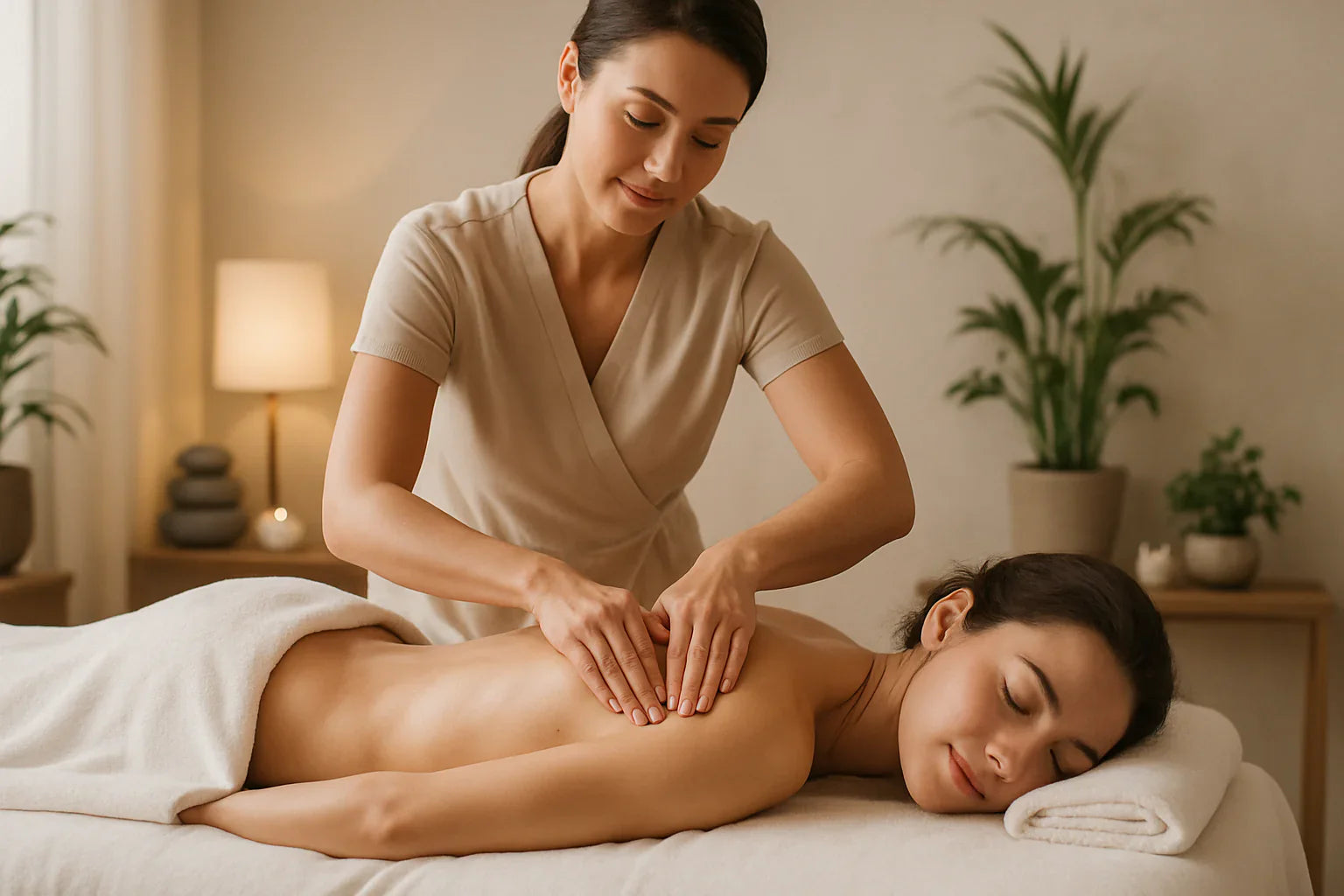
Massage - the pleasant and the useful
Massage has two common connotations. Some associate it with rehabilitation, others with a luxurious skincare treatment.
In reality, massage is not just rehabilitation or an extravagance, but above all one of the key elements of physical and mental health prevention.
It is worth starting to get massages before anything starts to ail us. Why?
A moment of relaxation - how massage affects the psyche
We will start with the most important thing - the mind.
Relaxation is not laziness or self-indulgence. A moment of rest and a reset is essential for the proper functioning of our mind and body. There is no need to convince anyone that when we are overworked and exhausted, we feel worse, become irritable, think more slowly, lack creativity, and above all, all joy of life disappears.
How does our body react to stress? Our body becomes tense and stiff (increased muscle tone). As a result of primary mechanisms, the secretion of so-called stress hormones increases: glucocorticosteroids, adrenaline, and noradrenaline. The immune system is weakened, and resistance drops. We often sleep poorly or even suffer from insomnia.
Massage causes a reduction in muscle tone. It reduces neurotic states and mental tension, and supports the treatment of insomnia. During a massage, there is an intense release of hormones: endorphins and serotonin, which are responsible for the relaxation and relief of the body. Furthermore, an increased level of endorphins also increases resistance to stress.
Simply put: during a massage, not only does our body relax and rest, but so does our mind.
Relaxation - the influence of massage on muscle tissue
Muscle tissue is a very important element of the musculoskeletal system. Thanks to muscles, not only does movement occur in the joints, but they also participate in important metabolic processes of the body.
Massage allows for the regeneration of muscles, including skeletal muscles - when left to their own devices, they take much longer to get back into shape. It regulates muscle tone and supports the ability of muscles to contract and relax. It also supports the removal of substances like lactic acid (the cause of muscle soreness), which leads to an increase in their mass and strengthens their internal structure.
An interesting fact is that massage can be applied to a location other than the site of an injury. This is called contralateral massage. Such massage is used, for example, when we have an immobilized left leg and it cannot be treated. In that case, we massage... the right leg, to stimulate the injured one. Such massage exerts about 20% of its effect on the other limb.
Connective tissue in general and in detail
All organs and systems of our body are built from connective tissue. It takes many forms, such as loose connective tissue, dense connective tissue, cartilage tissue, and bone tissue. Massage affects every form of connective tissue.
The influence of massage on loose connective tissue:
- during massage, the collagen and elastin fibers become more elastic, which means the loose tissue becomes more flexible,
- it becomes better supplied with blood and nourished, which leads to an improvement in the vital functions of organs.
The influence of massage on dense connective tissue:
- during massage, its fibers become more elastic and strengthened,
- accelerated regeneration of the fibers occurs.
The influence of massage on cartilage tissue:
- during a massage, the cartilage tissue is better nourished, which acts as a preventative or therapeutic measure in the case of degenerative changes.
The influence of massage on bone tissue:
- while performing certain massage techniques, the nutrition of the bone tissue improves,
- it maintains homeostasis between organic and inorganic compounds,
- in the case of fractures or cracks, it accelerates the ossification process.
Circulatory systems - the influence of massage on the cardiovascular and lymphatic systems
The cardiovascular system delivers necessary nutrients and removes waste products of metabolism. It also maintains internal homeostasis in the body at the proper level. It is connected to the lymphatic system, through which lymph flows. This system is part of the immune system.
During a massage, local congestion occurs, which causes better oxygenation and nourishment of cells. Metabolism and the removal of waste products are accelerated. Arterial blood pressure decreases, which has a positive effect on the work of the heart muscle. Blood vessels dilate, and circulation accelerates. Swelling and edema are absorbed faster.
Smooth as a baby - the influence of massage on the skin
The skin is our largest organ. This "suit" plays a protective and thermoregulatory role.
The effect of massage on the skin is visible to the naked eye. The stratum corneum of the epidermis is exfoliated, which contributes to better oxygenation of cells and their rejuvenation. Active substances can be introduced in a faster and more effective way - that is why beauty salons, among others, use this treatment. The openings of sebaceous and sweat glands are unblocked, which contributes to cleansing the skin. Its elasticity and resilience increase.
Breathe deep - the influence of massage on the respiratory system
The work of the respiratory system is closely linked to the work of the circulatory system. The respiratory system delivers oxygen taken from the environment to the tissues and expels carbon dioxide.
Thanks to massage, lung ventilation and the respiratory capacity of the body improve. Histamine secretion increases, which leads to the constriction of the bronchial tree and useless lung surface area. The intercostal muscles are strengthened, which in turn leads to increased mobility in the sternocostal and sternovertebral joints, thereby increasing the volume of the chest and stimulating breathing.
Furthermore, through tapping the chest and back, congestion in the bronchial tree and lungs is removed - which is why we reflexively pat our backs during colds and wet coughs.
The influence of massage on the digestive system
It might seem that massage has nothing to do with the digestive system. Yet it significantly improves its functioning.
Massage stimulates the secretion of gastrointestinal hormones. It accelerates the digestion of food and the excretion of products that have not been digested. It also improves metabolism.
Keep calm - the influence of massage on the nervous system
The nervous system plays a very important role in the functioning of the body. It receives information reaching the body, analyzes it, and sends feedback. It directs and controls the work and activities of individual organs and body systems.
Massage indirectly affects the central nervous system and normalizes the work of individual organs. It also influences nerve endings, improving muscle conduction. By massaging the spine, we act in a stimulating or calming way on the sympathetic system, and by massaging the neck, we influence the spinal nerves and their plexuses.
Massage also influences the restoration of proper nerve conduction.
Massage yourself for health
It is difficult to overestimate the beneficial effect of massage on our body. It is therefore worth setting aside at least 15-20 minutes a day to undergo this treatment. You can successfully perform such a treatment in your own home. Various massagers and massage chairs will come to your aid.
Share:
Massage mat - how to choose the right one?
Purchase of a massage chair for the company