

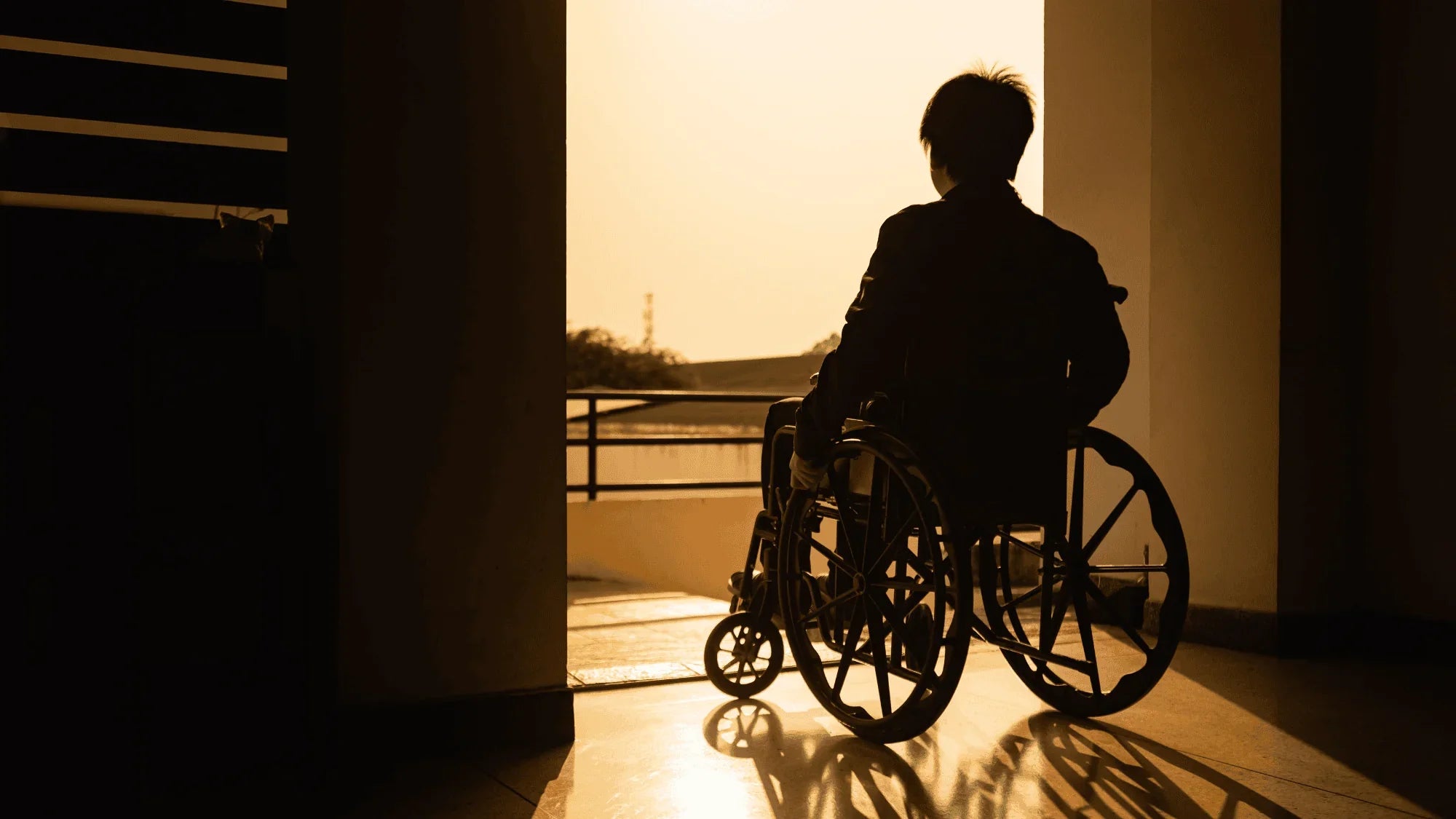
Paweł has cerebral palsy, hydrocephalus, Dandy-Walker syndrome (DWS)*, and profound intellectual disability. He suffers from contractures, increased muscle tone, and has a subluxated left hip. He does not speak or walk. He was expected to be bedridden, yet he can sit, which allows him to move around in a wheelchair. He requires 24-hour care and rehabilitation. He needs to be washed, dressed, fed, lifted, laid down, and have his diapers changed.
Paweł is 17 years old and weighs 80 kg.
Daily Life
Being a caregiver for a child with a disability is a role that one cannot imagine. It is mental and physical work equivalent to several full-time jobs, with irregular hours and no vacations.
Paweł requires full care – everything around him must be done for him. Because of his increased muscle tone and hip subluxation, he often feels pain and discomfort and needs his position changed. He also experiences states of intense agitation, during which he gets upset and screams. It is difficult to calm him down, especially since it is unknown what the cause of his agitation is.
Sometimes Paweł has sleepless nights. His mother also has a sleepless night then, even though she has to get up in the morning and do everything that needs to be done.
Paweł's father works, so care for Paweł largely falls on his mother's shoulders. And it was his mother who came up with the idea of buying a massage chair for Paweł, which would help with his daily rehabilitation. Until now, Paweł has been rehabilitated twice a week at the center he attends (the "Iskierka" Therapeutic Center in Grywów).
- One day, an advertisement for Casada popped up on my Facebook – says Ms. Ania, Paweł's mother. - I spontaneously called you and got through to Ms. Agnieszka. Ms. Agnieszka told me about the massage chair: how it works, what its applications are in rehabilitation, and how it can improve Paweł's daily functioning, and ours as his parents, as well. And she wasn't wrong in a single word. It is exactly as she said.

Funding from PFRON – it's not as scary as it seems
- I learned about the possibility of obtaining funding from PFRON for the purchase of the chair from Ms. Agnieszka. She was the one who guided me and explained the entire procedure. So, I decided to take advantage of this opportunity, especially since we had practically never asked the PCPR (District Family Assistance Center) for funds for Paweł before. And yet, raising a child with a disability entails significant costs. My son is growing: so every three years, we had to replace his wheelchair, rehabilitation bed, and patient lift. Until now, we bought all this with our own money, and these are items often costing from several to over a dozen thousand zlotys. On top of that, there are daily expenses: diapers, personal hygiene products, and medication.
When we found out that there was a possibility to apply for funding, we decided to try. Of course, there were some formalities to be taken care of, but it was nothing complicated. A prescription for the equipment had to be issued by a rehabilitation doctor or an orthopedist, and the visit had to be covered by the National Health Fund (NFZ) – you cannot obtain such a document during a private visit. Naturally, Paweł’s rehabilitation doctor was positive about the idea of using a chair in his daily rehabilitation and wrote the prescription without any issues.
However, the official at the PCPR said that they would not subsidize such equipment because such a chair is home spa equipment, not rehabilitation. Ms. Agnieszka came to the rescue again: I presented documentation confirming that the Casada massage chair is a rehabilitation device, including an opinion from the Wiktor Dega Orthopedic and Rehabilitation Clinical Hospital in Poznań, where patients of the Day Ward of the Rehabilitation Clinic of the Poznań University of Medical Sciences use Casada massage chairs, and ultimately we received funding covering 80% of the chair's value.
The official's initial reaction likely stemmed not from ill will, but from a lack of knowledge. Fortunately, there is documentation that confirms not only the fact that such a device is used in professional medical rehabilitation for various conditions but also documents the improvement in patients' physical condition, their quality of life, and their well-being, which is no less important. Remember that these are severely ill, suffering people with no chance of a cure – so we are fighting primarily to ensure they stay in the best possible physical and mental condition for as long as possible and to alleviate their daily ailments.
Massage chair - Paweł's favorite place
- Paweł spends a lot of time in the massage chair. He asks for the chair himself – although he doesn't speak, he communicates it very clearly. He not only likes the massages, but the position his body is in also helps him. You can see that nothing hurts him, that he feels no discomfort – neither in a sitting nor in a lying position. Therefore, when he returns home after classes at the center, he eats dinner and then spends his rest time not in his bed, but in the massage chair.
Paweł most often uses two massage cycles in succession. And then he sits in the switched-off chair for a long time after the massage is finished, listening to music from its speakers. And I don't have to worry that Paweł will fall out of the chair. He is safe in it even without safety belts – says Ms. Ania.
The chair also has a soothing effect on Paweł.
- When he starts to "rebel," gets agitated, or screams, we put him in the chair. Paweł calms down immediately, especially when his favorite music is played through the chair's speakers. And as soon as the massager starts, Paweł focuses on the fact that something is happening on his back, that it feels nice, that it is good. He stops screaming and quiets down.
...and the whole family
Ms. Ania fell in love with the chair from the very first day.
- When the package arrived, I didn't wait for my husband. I brought the chair in with my brother-in-law, then unpacked it. It turned out that the chair is quite bulky, but assembling it is not complicated. My husband only had to screw in the bolts on the footrest.
Ms. Ania uses the massage chair from the morning. She also ends her day with a massage.
- I feel relief. In the morning, I do a double massage. My husband laughs that I'm overdoing it, but I feel the need for it and, above all, I feel better. Previously, I had constant headaches and back pain. Since I have been regularly using the chair, my headaches are much less frequent. Now, in the winter, when we had half a meter of snow and temperatures of several degrees below zero, the chair brings me back into shape after shoveling snow – especially since the chair has a heating function. Whenever I'm exhausted, I sit in my royal throne and rest.
My husband also uses the massage chair – he relaxes in it in the evenings. And my 70-year-old mother, who has rheumatic degeneration, joint problems, and also suffers from a stiff neck. The chair massage helps her a lot; she uses it whenever she visits us. And, of course, our friends and neighbors do too. Everyone is delighted; everyone feels better after a massage.
What would Ms. Ania like to say to other parents of children with disabilities?
- For us, the chair passed the test 100%. It works for Paweł with his disability, it works for us parents who carry this child. Everyone who has a child with a disability, especially a teenager, should have such a rehabilitation device – it is also worth trying to obtain funding, because our children simply deserve it.
The path to obtaining funding for the purchase of home rehabilitation equipment is not always paved with roses, but it is not always bumpy either. Do not be discouraged by initial difficulties. It is always worth presenting documentation along with your application that confirms the use and effectiveness of the requested device in the rehabilitation of the given condition.
Remember that you are not alone – our team will provide you with detailed information and guide you step-by-step through the entire procedure.
***
*Dandy-Walker syndrome (Dandy-Walker malformation – a syndrome of congenital hindbrain defects, which includes hypoplasia of the cerebellar vermis, dilation of the fourth ventricle, and the presence of a cyst in the posterior cranial fossa, hydrocephalus as well as high placement of the cerebellar tentorium. The clinical presentation of DWS includes cerebellar symptoms, nystagmus, psychomotor retardation, hypotonia, strabismus, myopia and cranial nerve palsies.
Share:
Reflexology: the secret of the human foot
Casada Massage Chair Ranking – Best Models for 2026