

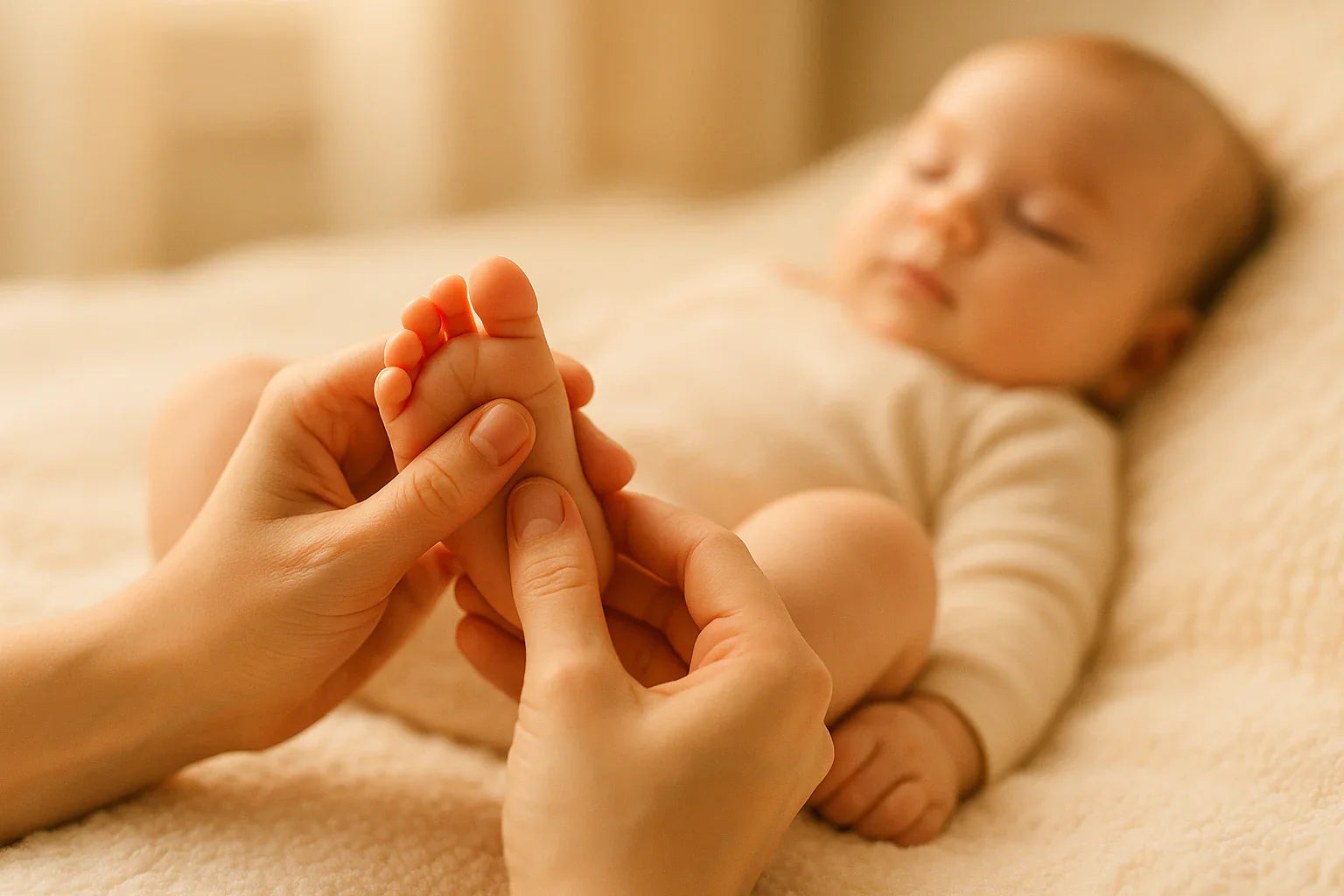
It might seem that massage is a form of rehabilitation or relaxation reserved exclusively for adults. We get massages because something hurts, because we are tense, because it’s hard to stand up straight without one, because it’s simply pleasant… so why would a child need a massage, especially a newborn who sleeps almost all the time? And yet, massage is more than just therapy for muscle aches. Manual massage is, above all, the touch of another human being. For a tiny human, the soothing warmth of a mother’s loving touch is the most important thing in the world.
Shantala massage is not a novel idea or a fleeting trend that has captivated moms obsessed with a healthy lifestyle. It is an ancient technique originating from India, and knowledge of it reached a wider European audience in 1976, when French obstetrician Frederick Leboyer described it in the book "Shantala. Traditional Art. Baby Massage" (orig.: “Shantala. Un art traditionnel: le massage des enfants”).
Leboyer himself discovered it by accident when, during his stay in Calcutta, he noticed a poor woman sitting on the ground massaging her child with calm, rhythmic movements. The name of this massage technique, as we know it, comes from the woman’s name.
Why is it worth massaging such a tiny baby?
Focusing strictly on the impact of massage on a baby's body, it should first be emphasized that it stimulates the development of the nervous system. Remember that the skin is, in a sense, a representative of our brain; it contains a huge number of receptors, and through touch, we transmit and activate certain information. New neural connections are formed in the brain, which develop, among other things, through touch. These connections never disappear.
The greatest number of connections in the brain develop in children up to the age of 10, which is why it is especially worth taking care of this during the first stage of a child's life, when the brain is developing most rapidly. Stimulating receptors in the skin through touch also stimulates the development of the circulatory and endocrine systems—in other words, it improves circulation. In infants, circulation and thermoregulation are weak and still developing. With massage, we stimulate circulation and improve it in the upper and lower limbs, which are most often cold in infants.
Shantala massage also affects muscle tone and helps to regulate it. If the tone is increased, we can relax it through massage and soothe the child.
Another system that this massage technique positively influences is the digestive system. Infants often experience colic and gas, and massage speeds up intestinal peristalsis, thereby regulating bowel movements. One could therefore say that it prevents gas and can even have an anti-colic effect.
It is worth mentioning here that there is a theory that colic in children is caused by an excess of stimuli—an overload of impressions that the child reacts to in this very way. Massage, by acting on the muscles, skin, and circulatory system, simultaneously affects the nervous system. By eliminating muscle tension and restoring a normal heart rate and blood pressure, it calms and quiets the child, minimizing the risk of colic. In turn, facial massage favors the development of the speech apparatus and positively influences the development of chewing.
For Physis and Psyche
Shantala massage also has—or perhaps primarily has—a huge impact on a child's psyche. One does not need to be convinced of how important the role of touch is in human development. A small human begins to receive tactile stimuli already in the mother’s womb, at 5–6 weeks of fetal life.
Touching a newborn, not only during massage but during all care activities, stroking them, stabilizes the child’s emotional development, awakens a sense of security and trust in them, and has a positive impact on IQ levels, and in the future, on the ability to form proper relationships with other people and a healthy sense of self-worth. Massage calms the child, helps them cope with stress, and builds resilience to it. It also improves the contact between parent and child, helping them learn about each other.
What is the best thing about Shantala massage?
Certainly, the fact that it is not a rehabilitative massage and, after brief training, any parent can perform it on their child. It might seem like a paradox that an uneducated, poor Indian woman knew something that 20th-century doctors did not.
On the other hand, she was certainly closer to nature than all the doctors put together... And touch is, after all, the most natural reaction we offer another human being to soothe their pain, emphasize our presence, or express love. Sources: dziecisawazne.pl, parenting.pl, mjakmama24.pl, estrefazdrowia.pl, newsweek.pl
Share:
How to choose a massage device
Casada Medical - more than just a massage