

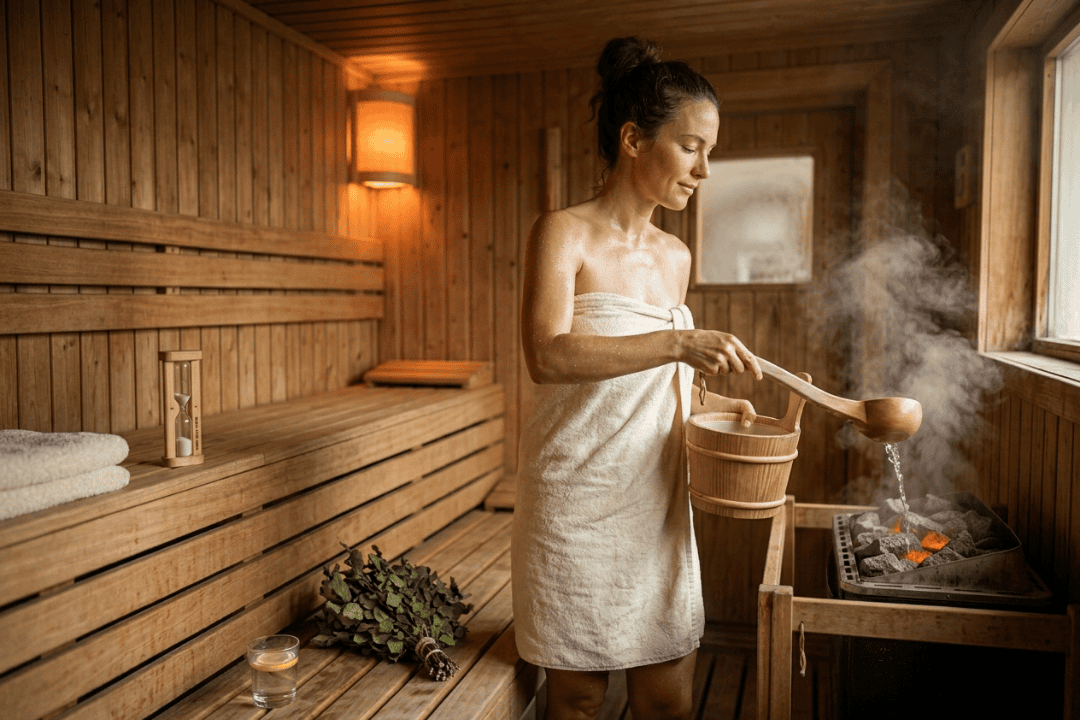
Saunas have been part of human culture for thousands of years, and modern science is finally catching up with what Finns have known for generations. Regular sauna use alters the function of the heart, immune system, and nervous system. But how exactly does it work? Who benefits, and who should be cautious? And what is the difference between a Finnish sauna and an infrared sauna?
How does a sauna affect the body?
While in a sauna, body temperature can rise by 1–2°C, and skin temperature can reach about 40°C. The body interprets this state as mild thermal stress and triggers a cascade of physiological reactions which—when repeated regularly—have far-reaching health benefits.
- Cardiovascular system - Heart rate increases to 120–150 beats/min—an effect comparable to moderate physical exercise. Blood vessels dilate, and blood pressure temporarily drops.
- Hormonal balance - Levels of endorphins, noradrenaline, and growth hormone increase. Cortisol—the stress hormone—decreases.
- Immune system - Hyperthermia stimulates the production of white blood cells and heat shock proteins (HSPs), which support cell regeneration.
- Muscles and joints - Heat relaxes tense muscles, improves tissue elasticity, and accelerates the removal of lactic acid after exercise.
- Nervous system - Regular sessions reduce anxiety, improve sleep quality, and alleviate symptoms of depression—confirmed by clinical studies.
- Respiratory tract - Hot, humid air (especially in a Finnish sauna) moisturizes mucous membranes and facilitates expectoration of secretions.
Finnish sauna vs. infrared sauna — key differences
Both saunas work by heat, but they deliver it in completely different ways—and yield slightly different health effects. The choice between them should depend on your goals and health status.
Finnish sauna — tradition and intensity
A Finnish sauna features temperatures of 80–100°C, a wooden stove with stones (kiuas), and the tradition of pouring water with aromas over it—known as löyly. The high air temperature and temporary humidity spikes maximally stress the thermoregulatory system, leading to intense sweating, rapid vessel dilation, and very strong stimulation of the circulatory system. It is particularly suitable for healthy individuals and athletes.
Infrared sauna — depth and gentleness
An infrared sauna operates at temperatures of 45–65°C, but IR-A and IR-B radiation penetrates directly into body tissues—heating them from the inside, rather than from the outside. As a result, the therapeutic effect (muscle relaxation, improved circulation, detoxification) is comparable to that of a Finnish sauna, with significantly less strain on the body. This solution is often chosen by older individuals, those with chronic joint pain, and those who do not tolerate very high temperatures.
Sauna and the heart and circulatory system
Sauna and the heart is a topic that raises many questions—and many misconceptions. Contrary to popular belief, regular sauna use is beneficial for the cardiovascular system in healthy adults.
Long-term Finnish cohort studies (including over 2,000 men observed for 20 years) showed that people who used the sauna 4–7 times a week had about a 50% lower risk of cardiovascular death compared to those who used the sauna once a week.
It has been observed that regular sessions lower resting blood pressure—an effect similar to aerobic endurance training. Cyclic dilation and constriction of blood vessels act like cardio training for the endothelium—improving its function and elasticity.
Individuals who have had a heart attack, have uncompensated heart failure, unstable angina, arrhythmias, conduction blocks, or valvular defects should not use a sauna without prior cardiological consultation. In the stable phase of coronary artery disease, an infrared sauna may be permissible—always after consultation with the treating physician.
Sauna for a cold — myth or fact?
The question of sauna use during a cold arises every season. The answer is more complex than the popular "sauna cures a cold."
Sauna as prevention — YES
Regular sauna use before the infection season genuinely boosts immunity. Hyperthermia stimulates the production of white blood cells and interferons, and heat shock proteins (HSPs) help immune cells recognize pathogens more quickly. Finns, who regularly use saunas year-round, statistically experience fewer and milder upper respiratory tract infections.
Sauna at the onset of a cold — CAUTIOUSLY
If you are just feeling the first symptoms—chills, mild muscle aches, a general feeling of malaise—a single sauna session might shorten the duration of the infection by temporarily raising body temperature, which hinders viral replication. However, it requires good hydration and rest after the session.
Sauna during fever or angina — NO
If you have a fever above 38°C, bacterial angina, sinusitis, or flu with high temperature—sauna use is absolutely contraindicated. The additional thermal stress with a fever can lead to dehydration, collapse, and complications.
Can children use saunas?
Sauna and children is a topic about which parents have many doubts. A child's body has much less efficient thermoregulation than an adult's—sweating as a cooling mechanism develops gradually, and young children can overheat quickly and without clear warning signs.
Children under 3 years old
Saunas—both Finnish and infrared— are not recommended for children under 3 years of age. Their thermoregulatory system is not yet sufficiently developed to safely handle extreme temperatures.
Children 3–12 years old
Children in this age group can use a sauna with a few safety precautions:
- Always accompanied by an adult—a child should never be in the sauna alone.
- Maximum temperature of 70°C in a Finnish sauna or use the lower bench (cooler zone).
- Short sessions—maximum 5–8 minutes, without interruption for a cold shower.
- Drink plenty of water before and after the session.
- At the first signs of discomfort—immediate exit.
- An infrared sauna at a low temperature (45–50°C) is a milder alternative for children.
Adolescents over 12 years old
Teenagers can use the sauna on almost the same principles as adults, with common sense regarding session length and hydration.
Who should not use a sauna?
Sauna use is safe for the vast majority of healthy adults—but there are conditions where caution is needed or heat bathing should be avoided entirely.
Absolute contraindications
- Fever above 38°C—additional thermal stress can lead to collapse.
- Acute myocardial infarction or stroke (acute phase and early recovery).
- Uncompensated heart failure—the heart cannot cope with heat dissipation.
- Pregnancy—especially the first trimester; elevated temperature can be dangerous for the fetus.
- Active inflammatory conditions—bacterial infections, abscesses, phlebitis.
- Uncontrolled epilepsy—heat can lower the seizure threshold.
- Alcohol consumption—alcohol and sauna are a dangerous combination (risk of collapse, thermoregulation disorders).
Conditions requiring medical consultation
- Stable coronary artery disease or post-infarction state (in remission phase).
- Diabetes—especially insulin-dependent (risk of hypoglycemia and blood pressure changes).
- Kidney diseases (disruption of water balance).
- Multiple sclerosis and other demyelinating diseases—excessive heat can exacerbate symptoms.
- Use of diuretics, beta-blockers, or vasodilators.
- Skin diseases—some dermatoses may worsen under the influence of heat and sweat.
How to use a sauna correctly?
Knowing how to use a sauna is half the battle. Even the best-equipped home sauna will not provide benefits if used irregularly or without observing basic rules.
Before entering the sauna
- Take a warm (not hot) shower—it cleanses the skin and facilitates sweating.
- Hydrate—drink a glass of water or an isotonic drink; avoid coffee and alcohol.
- Remove jewelry and watches—metal heats up quickly.
- Prepare a towel to sit on and an extra one to dry off after leaving.
- Do not enter immediately after a heavy meal—wait at least 1–2 hours.
During the session
- Enter calmly and lie down or sit—a reclining position ensures even body heating.
- Don't force the time—for the first sessions, 8–10 minutes is entirely sufficient.
- Breathe calmly and deeply through your nose.
- Listen to your body—dizziness, heart palpitations, nausea are signals to exit immediately.
Cooling down — a key element of the ritual
A cold shower, cold water, or stepping out into fresh air after leaving the sauna is not just a tradition—it's the moment when blood vessels rapidly constrict, which enhances the "training" effect for the circulatory system. Cooling should be gradual: first cool air, then cool water, finally cold water.
Rest between sessions
After cooling down, rest for at least 10–15 minutes—the body equalizes temperature, heart rate returns to normal. This is a time to rehydrate and breathe calmly. A full sauna ritual usually consists of 2–3 cycles with cooling and rest in between.
How often and for how long — optimal sessions
One of the most common questions is: how often should you use a sauna to reap its health benefits? The answer depends on the type of sauna, your health status, and experience.
Finnish sauna — time rules
A standard session in a Finnish sauna lasts 8–15 minutes. Experienced users can extend it to 20 minutes, but this is not necessary—studies show that most health benefits appear after just 10–12 minutes. The maximum temperature is approximately 80–100°C (higher bench = higher temperature).
Infrared sauna — longer, but gentler
Due to the lower ambient temperature, an infrared sauna session can last longer—typically 20–30 minutes, and for accustomed individuals, even up to 40 minutes. The heat penetrates deeper, so the effects are still intense, even though the air is not scorching hot.
How to start — first weeks
- Weeks 1–2: 1–2 times a week, one session of 8–10 minutes, at the lower end of the temperature range.
- Weeks 3–4: 2–3 times a week, two sessions of 10 minutes with a 10-minute rest in between.
- After a month: 3–4 times a week, 2–3 sessions—standard protocol for a healthy adult.
- Listen to your body—the pace of adaptation is individual. There is no pressure to "endure" longer.
A home sauna—Finnish or infrared—allows you to build a habit of regular sessions without leaving your home. Regularity, not intensity, is the key to long-term health benefits. Even 2 sessions per week throughout the year provide measurable benefits for the heart, nervous system, and immunity.
Share:
How to choose a hot tub? What to look for before buying
Sauna and weight loss — facts instead of myths