

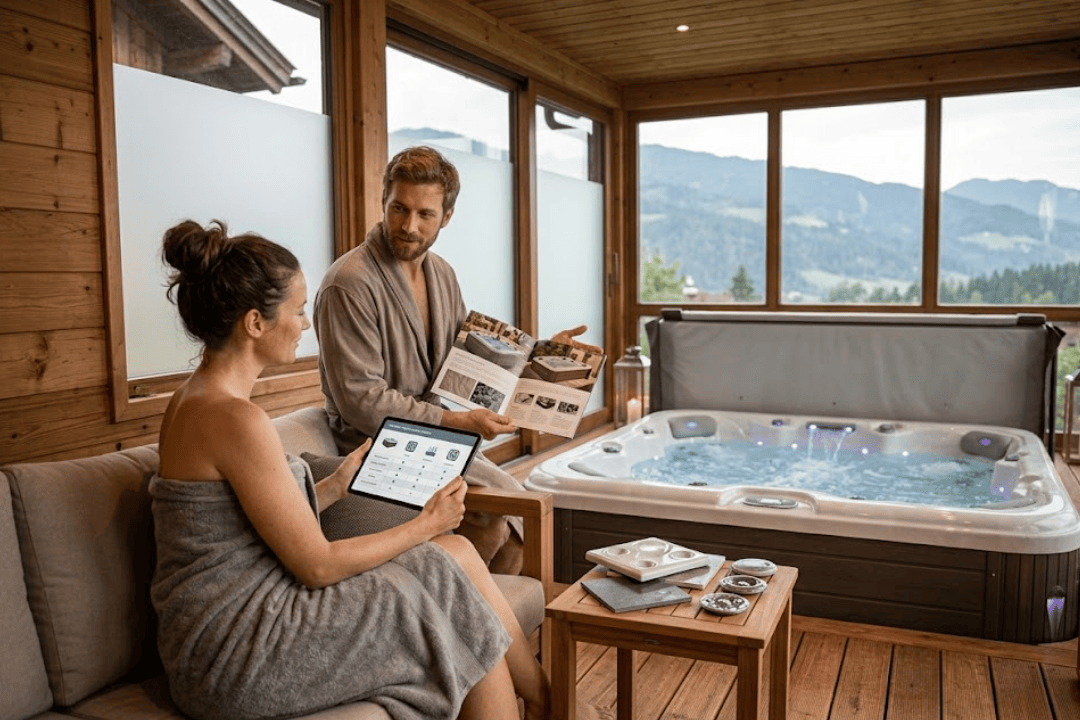
A hot tub is a dream for many – and choosing the right model doesn't have to be difficult if you know what to look for. Size, number of jets, material quality, filtration system – each of these elements matters. This guide will walk you step-by-step through all the key criteria for purchasing a hot tub.
Jets and water streams – quality over quantity
One of the most common mistakes when choosing an outdoor hot tub is focusing solely on the number of jets. However, the number of openings alone says nothing about the quality of the massage – the balance of water and air flow relative to pump power is crucial.
If this balance is disturbed, the jets may work too weakly to provide an effective hydromassage. Instead of counting jets, ask about pump power and flow rate in liters per minute.
SidoraConcept Tip
Consider which body parts you want to massage most often – back, legs, feet, neck, or hands. A good hot tub should have jets positioned exactly where you need them, not evenly distributed everywhere.
It's also worth knowing that in most models, each seating or lounging position has differently arranged jets – this way, by changing your position, you can massage different muscle groups. This thoughtful solution transforms an outdoor hot tub into a true hydrotherapy device.
- Check the pump power (in HP or kW) – this is a more important parameter than the number of jets.
- Ask about intensity adjustment for individual massage zones.
- Choose a model with jets targeted at the body parts you need.
- Pay attention to the ability to switch off selected jets – adjustable comfort is a big plus.
Material quality – what to really look for
Material quality is one of those aspects that directly translates into the durability and appearance of a hot tub after a few seasons of use. It's not worth cutting corners on this element.
Inner shell
It should be resistant to scratches, discoloration, and the action of water treatment chemicals. The best models are made of multi-layered acrylic reinforced with fiberglass – this material is lightweight, durable, and easy to clean.
Outer casing
The outer casing of an outdoor hot tub is exposed to sun, frost, and moisture all year round. It must be UV-resistant – without this property, the color fades and the material cracks after just a few seasons. Check whether the manufacturer lists UV resistance as a technical parameter, not just a marketing slogan.
- Acrylic shell - Lightweight, warm to the touch, resistant to discoloration. Standard choice for most models.
- UV-resistant casing - Ask for certified UV resistance – this protects the color and structure for years of use.
- Thermal insulation - Good insulation means lower electricity bills – heat is retained longer without reheating.
Filtration and water treatment – health and comfort
Crystal clear water is one of the biggest advantages of a good garden hot tub – but it requires an efficient filtration system. Poor filtration means cloudy water, unpleasant odor, and the need for frequent water changes.
Pay attention to the efficiency of the filtration pump – it should circulate the entire volume of water at least twice a day. Many models are equipped with programmable filtration cycles that automatically start at scheduled times, resulting in consistently clean water with minimal effort.
- Check the efficiency of the filtration pump (l/h) relative to the tub's capacity.
- Choose a model with a programmable filtration schedule.
- Ask about compatibility with water treatment products (chlorine, bromine, chlorine-free systems).
- Find out how often and how easily filter cartridges are replaced.
Good practice
Even the best filtration system should be supported by dedicated hot tub water treatment products. Spa water care products significantly extend the time between water changes and ensure hygienic bathing.
Hot tub size – match it to your space and needs
When choosing the size of your hot tub, consider three factors: available space, the number of people who will use it, and the intended use (social relaxation or a private rejuvenation ritual).
Remember one important rule: the number of seats does not necessarily depend on the tub's size. Sometimes, an additional seat entails only a few centimeters difference in external dimensions. It's worth checking this by comparing models with a similar footprint.
- Measure the available space, including the clearance around the tub (min. 60 cm on each side).
- Check the weight of the tub filled with water – the required subfloor bearing capacity is often 600–900 kg.
- Ensure the tub will fit into the planned location after installation (doors, gate, wicket).
- Consider access to electrical and water connections.
Number of seats and loungers
The choice between seats and loungers is primarily a matter of personal preference and how you intend to use your hot tub.
Loungers
Primarily designed for full relaxation – jets are distributed along the entire body, providing a massage from the neck to the feet. Loungers take up more space but offer the most comprehensive experience.
Seats
More compact and social – they allow comfortable face-to-face seating. Many models offer different seating levels: higher ones (with part of the body above water) are ideal for children or when you want to take a break from the hot water without leaving the tub.
Important: The more seating positions, the more massage zones – each seat has differently oriented jets. A 6-person hot tub offers more massage combinations than a 4-person model of similar dimensions.
Protective cover – do not underestimate this element
The cover is one of the most underestimated elements of an outdoor hot tub – yet, in practice, it has a huge impact on operating costs and maintaining water purity.
- Water protection— a tight cover prevents leaves, insects, and dust from entering.
- Thermal insulation— a good cover can reduce energy consumption by up to 40% by limiting heat loss.
- Safety— covers with locks are an important feature if children are present nearby.
- Fit for the model— always buy an original or certified cover for your specific model. An ill-fitting one will not protect or insulate effectively.
Accessories and entertainment features
Modern garden hot tubs offer a range of features that enhance comfort and enjoyment. It's worth knowing which ones have real practical application.
- LED Chromotherapy - Multi-colored lighting improves mood and creates a spa atmosphere. One of the most popular amenities.
- Control panel - Intuitive touchscreen for regulating temperature, massage mode, and lighting – standard in good models.
- Audio system - Built-in Bluetooth speakers are a popular addition for those who enjoy relaxing with music.
- Wi-Fi control - Ability to heat water remotely via an app – practical if you want to jump straight into a warm tub.
High-end models also offer built-in LCD screens and advanced aromatherapy systems. Before purchasing, consider which features you will actually use – each addition means a purchase cost and a potential repair cost.
Warranty and service – the foundation for worry-free use
When buying an outdoor hot tub, you're investing for years – which is why warranty terms and service availability are just as important as the technical parameters of the device itself.
- Warranty scope— ensure it covers not only the casing but also mechanical components: pumps, motors, control panel.
- Service in Poland— ask if the seller or importer provides local service and how quickly they respond to reports.
Choosing an outdoor hot tub is a decision that will pay off in daily comfort – provided you make it consciously. Instead of being guided solely by price or attractive appearance, consider all the criteria described above. The best garden hot tub is one that fits your space, meets your needs, and will be reliable for many seasons.
Share:
Infrared Therapy — Heat That Heals From Within
Sauna and health — what are the true benefits of regular use?